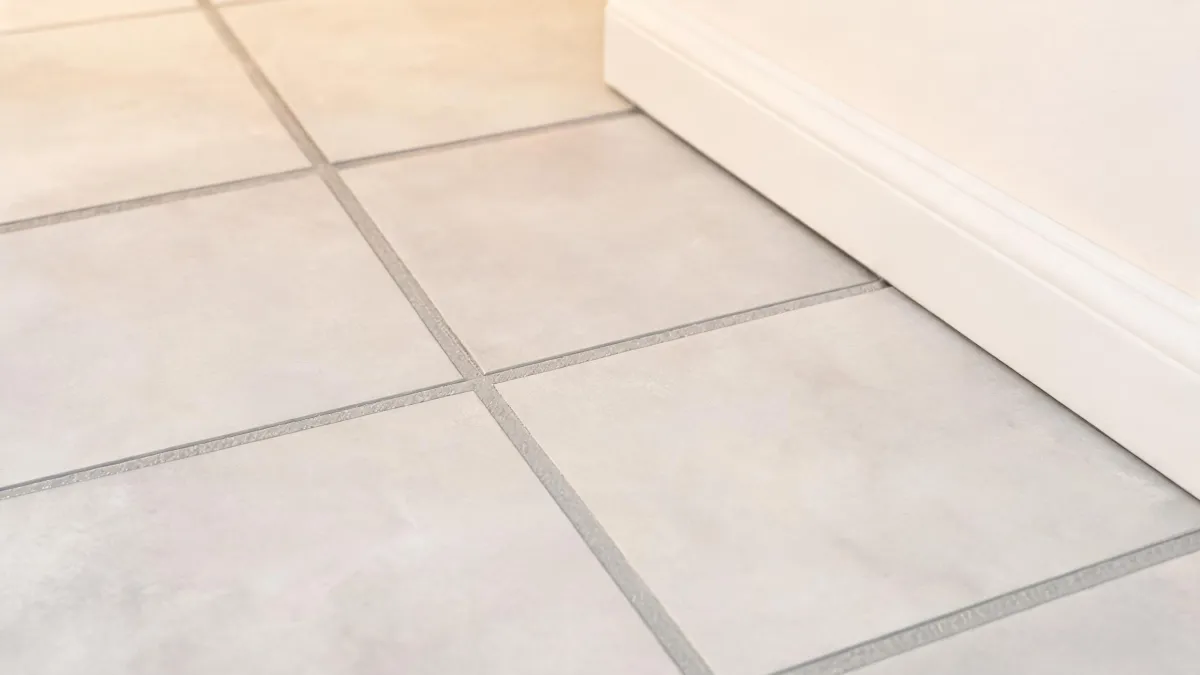
When our VP of Operations asked me, in the first week of October 2025, whether I could take over the breakroom renovation, I said yes before I understood the question. That was mistake number one. It wasn’t the last.
I’m the office administrator for a 180-person investment advisory firm. Translation: I buy everything that keeps the office alive—coffee, furniture, cleaning, toner—roughly $320,000 a year across a dozen vendors. I report to operations and finance, which means I care about invoices and schedules. Until last fall, I had never bought tile, never heard the phrase “mortar bed,” and I thought thin-set was one word for one thing. It is not.
The Spec That Fooled Me
The design consultant handed me a one-page spec. Floor: a Marazzi 24×48 porcelain tile in a honed marble finish. Wall behind the coffee station: a textured mesh-mounted mosaic from the same manufacturer. I didn’t know what the mosaic was called, so I typed my best guess into Google: “marazzi rice tiles.” That phrase became the shorthand on every order after that.
It looked easy. Manufacturer: Marazzi. Product code: on the page. Color: on the page. In my normal world, that level of detail is enough to order toner. I didn’t notice that the spec sheet had no adhesive category, no mortar notation, and no mention of what would hold a 24×48 slab of porcelain to our floor. The pretty part of a renovation is very good at hiding the unglamorous part.
Three Quotes, Three Kinds of Vendors
Searching “marazzi tile” gave me three very different places to spend money. A retail showroom in the city quoted list price plus a “project support” fee. An online discounter quoted $1,500 less but couldn’t produce a proper invoice and called the tile “100% green” without a single document to back it up. Per the FTC Green Guides (ftc.gov), environmental claims need to be substantiated, and I’d learned that lesson the expensive way in 2020, when a vendor’s friendly words cost our department $2,400.
Quick context I learned along the way: Marazzi is a global porcelain tile manufacturer with a real production history. But that doesn’t mean you call them and order. The brand moves through distributors, and a distributor’s website is not the same thing as the manufacturer’s website. Whoever you buy from, the invoice, lot numbers, and product data sheets need to survive a finance review.
The third quote came from a wholesale distributor on Marazzi’s own locator. Their office was in an industrial park twenty-five minutes away. Their number was the lowest of the three, which confused me until I realized that wholesale didn’t necessarily mean ordering a full truck. It meant they sold through a commercial channel, handled purchase orders, and invoiced like a company that expected repeat business.
They were also the only vendor who sent physical samples without making me feel weird about it—including the mosaic sheets, shipped in a USPS flat-rate envelope to our Dallas office (about $10 at the time; check usps.com for current rates, because postal pricing has a way of changing). That small gesture told me they understood what an office administrator needs to see before spending money.
The Mortar Moment
I placed the tile order in early December. The tile arrived on schedule, and the project felt like it was finally on rails. Then the lead installer arrived, looked at the boxes, and asked where the thin-set was. I pointed at the bags I’d bought from a national hardware store, because the label said “tile” and the price looked harmless.
The installer went quiet. Then he said, “This is a standard unmodified thin-set. It’s fine for small ceramic on a sound drywall. It is not the product I would use under a 48-inch porcelain plank on a concrete slab with foot traffic.” I asked what the difference was. He pulled a spec sheet from his truck and showed me the word “LHT”—large and heavy tile mortar. He said that for our size tile, the bag should meet ANSI A118.15. Mine did not.
The demolition crew had already come and gone. The cabinets were on order. The VP had promised the leadership team they could move into the renovated space after New Year, and I had roughly 48 hours to solve a problem I didn’t know existed two hours earlier.
The Question I Should Have Asked First
I called the wholesale distributor, embarrassed. The rep didn’t make me feel stupid. He asked three things: What is the substrate? What size and weight is the tile? What kind of traffic and moisture is the space going to see? Then he told me which mortar he’d use, why, and what standard was printed on the bag.
“If you’re asking how to choose mortar mix for wholesale,” he said, “start with the job, not the price per bag.” Then he walked me through it: for our concrete slab, an LHT mortar rated ANSI A118.15; for the mesh-backed mosaic on drywall, a polymer-modified thin-set suitable for porcelain; and a warning not to use the same product for both just because the rest of the project was on a deadline. Ten minutes on the phone saved us from a much more expensive problem.
Turns out I had not understood tile adhesive sourcing at all. I thought a bag was a bag. But adhesive and mortar are basically the engineering layer between the pretty surface and the building. If you match them to the right conditions, they disappear. If you don’t, they become the story of why the floor is wavy.
What I Keep Replaying
The corrected order cost roughly $180 more than the bags I threw away. The real damage was time—about five working days lost while we waited, rescheduled the cabinets, and paid the crew an extra visit. Add it up and it was close to $1,800 of mistake, and the embarrassment was free.
I’m not pretending this makes me a tile expert. My experience is one office renovation, one set of indoor commercial conditions. If your project involves exterior walls, masonry, or wet areas, ask someone who does that for a living before you buy anything. My lesson is not about which bag to buy—it’s about asking the questions before the schedule puts you in a corner.
It took one renovation and one very patient distributor rep to teach me the thing the contractor had tried to tell me before he started: buying the tile is the easy part. The hard part is everything underneath it.
The fundamentals haven’t changed, even if the channel has. Five years ago, I might have walked into a showroom, and a salesperson would have bundled the materials and made the adhesive decision for me. That convenience is not the norm anymore—and honestly, doing it myself made me a better buyer. But I still should have asked the substrate question before I placed the order, not after.
Also, for the record: if you search “marazzi rice tiles,” you’ll find the mosaic we used. Finding the product was never the problem. Knowing what you don’t know about it is the whole game.